Selecting a Flammable Safety Cabinet for Laboratory Chemical Storage
Flammable Safety Cabinet Buyer's Guide: Features, Sizes, Capacities, Self-Closing vs Manual Doors, OSHA & NFPA Compliance for Laboratory Chemical Storage
2026/11/16
Reading volume: 0
News Details
Why Flammable Liquids Need Dedicated Storage
Solvents, fuels and alcohol-based products are part of daily work in many laboratories and factories. Once the quantity of flammable liquids grows beyond a few bottles, ordinary shelving no longer protects your team. A flammable safety cabinet gives these liquids a dedicated, fire-resistant enclosure that controls vapors, contains spills and slows the spread of a fire. For international buyers planning laboratory chemical storage, the cabinet is usually the first and most important line of defense.
Regulators treat this equipment seriously. Under OSHA 1910.106 and NFPA 30, workplaces in the United States must use a flammable storage cabinet once Class I flammable liquids exceed 25 gallons outside of an approved cabinet. Many local fire codes apply similar rules, so buyers across education, healthcare and industrial projects often specify cabinets at the planning stage rather than after inspection.
What a Flammable Safety Cabinet Does
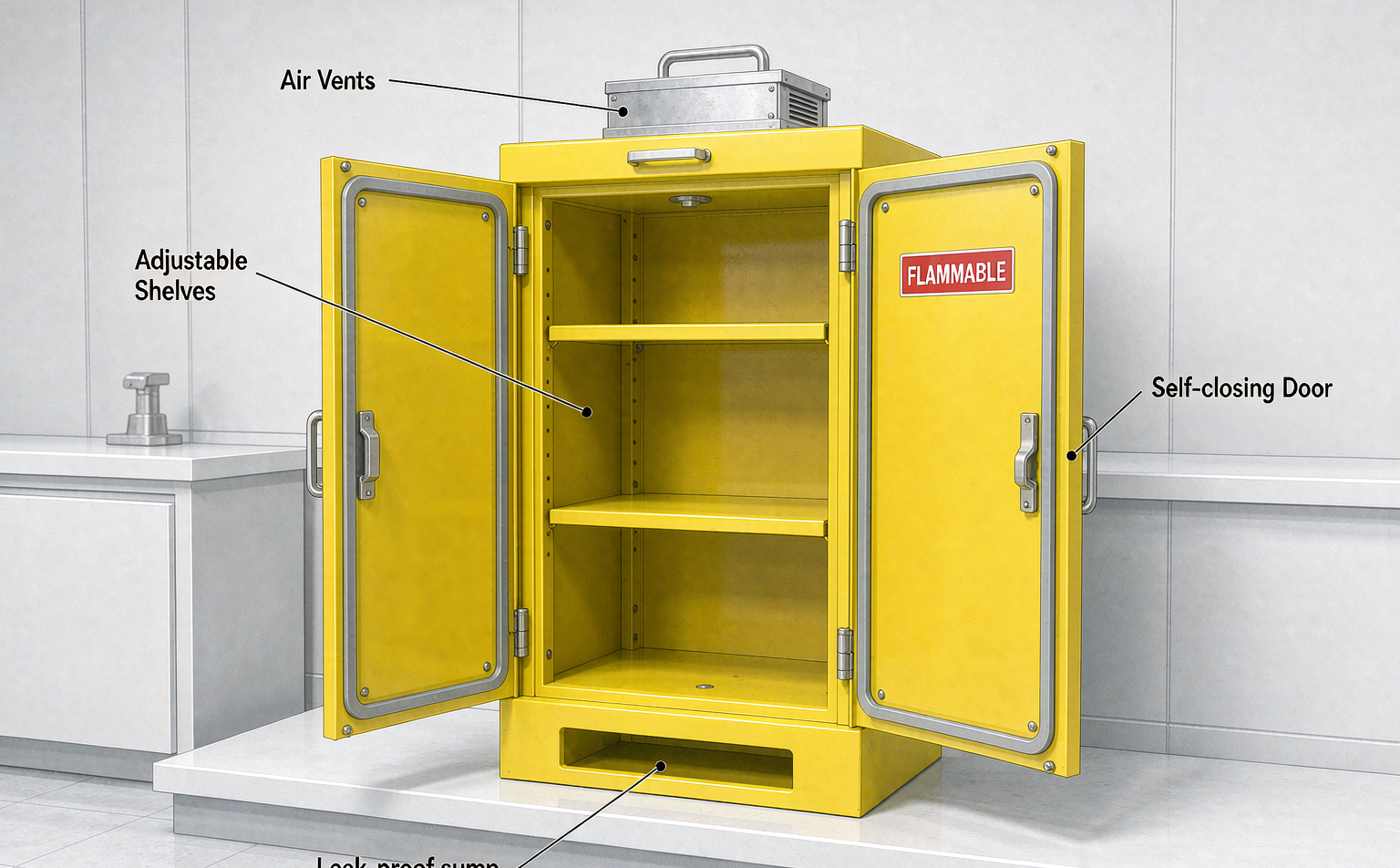
A flammable safety cabinet is more than a metal box. Its double-walled steel construction, with an insulating air space between the walls, is designed to delay heat transfer during a fire. Self-closing doors shut automatically so that flames and oxygen are cut off even when nobody is at the bench. A leak-proof sump at the bottom catches accidental spills, while built-in air vents allow safe connection to the laboratory exhaust system.
Inside the cabinet, adjustable shelves keep containers organized and prevent overfilling. Clear warning labels — “FLAMMABLE – KEEP FIRE AWAY” — remind every user of the hazard. Together, these features isolate the hazard, protect personnel and help a facility pass fire and safety inspections.
How to Choose a Flammable Storage Cabinet for Your Project
Start with your chemical inventory, not with the cabinet color. Review the safety data sheets (SDS) of the liquids you plan to store, and separate flammable liquids from corrosive acids and bases, which need different cabinet materials. Then confirm three practical points before you request a quote:
- Volume: How many gallons or liters must the cabinet hold, including future growth?
- Placement: Will it stand under a fume hood, against a wall, or in a shared prep room? Measure the footprint and door swing.
- Users: A single-person lab may prefer a compact one-door cabinet, while shared labs benefit from two-door models that allow faster access.
Buying for the actual workflow, instead of only the lowest price, avoids clearance problems and compliance issues at delivery.
Cabinet Sizes and Capacities Explained
Flammable safety cabinets are produced in a range of capacities so that a lab can match storage volume to real demand. Ample offers capacities from compact 4-gallon countertop units up to 110-gallon full-height models, with common mid-size options in between:
| Capacity | Typical application |
|---|---|
| 4–12 gallon | Small quantities, tight rooms or point-of-use storage |
| 22–30 gallon | Teaching labs and small research groups |
| 45 gallon | The most common choice for daily laboratory use; a typical footprint is about 1650 × 1090 × 860 mm |
| 60–90 gallon | Industrial plants and larger storage rooms |
| 110 gallon | Bulk storage where floor space allows a full-height cabinet |
Self-Closing vs Manual Cabinet Doors
Door type is a decision that affects both safety and code compliance. Manual-close doors stay open until a user shuts them, which is convenient during frequent handling but leaves the cabinet unprotected if a fire starts while doors are open. Self-closing doors use a fusible-link mechanism: at normal temperatures the doors can be held open, and when heat melts the link they close automatically to smother flames.
Many fire codes require self-closing doors, especially in occupied buildings and near exits. If your local authority having jurisdiction (AHJ) has not stated a preference, choosing self-closing, lockable doors is the safer default for most laboratories.
Meeting OSHA and NFPA Compliance Requirements
Compliance starts with the standard, not the sales sheet. In the United States, OSHA 1910.106 governs flammable liquids in general industry, while NFPA 30 defines construction requirements such as double-wall steel, liquid-tight sumps, self- and latch-closing doors and labeled vents. Third-party listings and certifications such as CE and EN marks are commonly requested by international buyers as evidence of tested performance.
Ample manufactures its flammable safety cabinet line from heavy-duty cold-rolled steel with fire-resistant double-wall construction, and its laboratory products are designed to align with CE, EN, NFPA and OSHA requirements. Before ordering, confirm the exact standards your project must meet and ask your supplier for the corresponding test or certification documents, so the cabinet that arrives matches the one your inspector expects.
Everyday Practice for Laboratory Chemical Storage
Even the best cabinet only works when it is used correctly. Store flammable and combustible liquids together in one cabinet only when they are chemically compatible, and keep corrosives in a separate acid cabinet. Do not block exits or walkways with the cabinet, and avoid improper venting that could feed oxygen to a fire. Keep container sizes reasonable, label waste containers clearly, and review the cabinet contents whenever the chemical inventory changes.
A simple rule helps most teams: the cabinet stores chemicals safely, while a fume hood manages exposure during use. The two controls work together, and planning both at the same time keeps storage, handling and exhaust decisions aligned.
A Practical Selection Checklist
- Confirm total storage volume and future growth before selecting a size.
- Choose capacity and door style for the room’s traffic and layout.
- Verify OSHA, NFPA and local fire code requirements with your AHJ.
- Ask for double-wall steel construction, a leak-proof sump and self-closing lockable doors.
- Request certificates or test documents for the standards you must meet.
With these points settled, a flammable safety cabinet becomes a long-term safety asset rather than a compliance afterthought. Ample supports laboratory and industrial projects worldwide with configurable capacities, customizable options and design-to-delivery service — contact the team to match a cabinet to your chemical inventory and floor plan.
Share to:


